



There is a quiet experience that many capable professionals share, yet rarely put into words. You are competent. You are putting in genuine effort. And for a while, that felt like enough. But slowly, without any single incident to blame, something shifts. Feedback starts to land harder than it should. Rejection lingers. You become guarded in meetings, tense in one-on-ones, and oddly drained by situations that once felt routine. You start wondering whether something is wrong with you.
The answer, as neuroscience increasingly suggests, has very little to do with motivation or character. It has everything to do with how safe your brain believes you are.
The real role of serotonin (it's not what most people think)
Most people have heard the simplified story: depression is caused by low serotonin. While serotonin is certainly involved in mood regulation, that framing misses something important. Neuroscientists now understand serotonin less as a "happiness chemical" and more as a social safety signal, a constant background read of the question, "Am I socially secure right now?"
When serotonin function is balanced, neutral feedback stays neutral. Rejection doesn't feel like identity damage. Setbacks feel temporary and survivable. But when serotonin activity drops, often as a result of prolonged social pressure, .ambiguous comments start feeling like attacks, silence starts feeling like rejection, and failure starts feeling deeply personal. This isn't weakness. It is the brain recalibrating to an environment it has learned to distrust.

How neuroscience actually induces depression in research
There is a well-established method used in neuroscience research to produce depression-like states in subjects. It is called social defeat stress, and it does not require neglect, trauma, or overt abuse. It requires something far more recognizable: being placed in a situation where effort does not reliably lead to relief, where status feels impossible to secure, and where small losses accumulate without recovery.
This distinction matters enormously in the context of modern workplaces, where high performers often work harder in response to stress, not realizing that the problem is structural, not motivational.
What chronic social pressure does to the brain
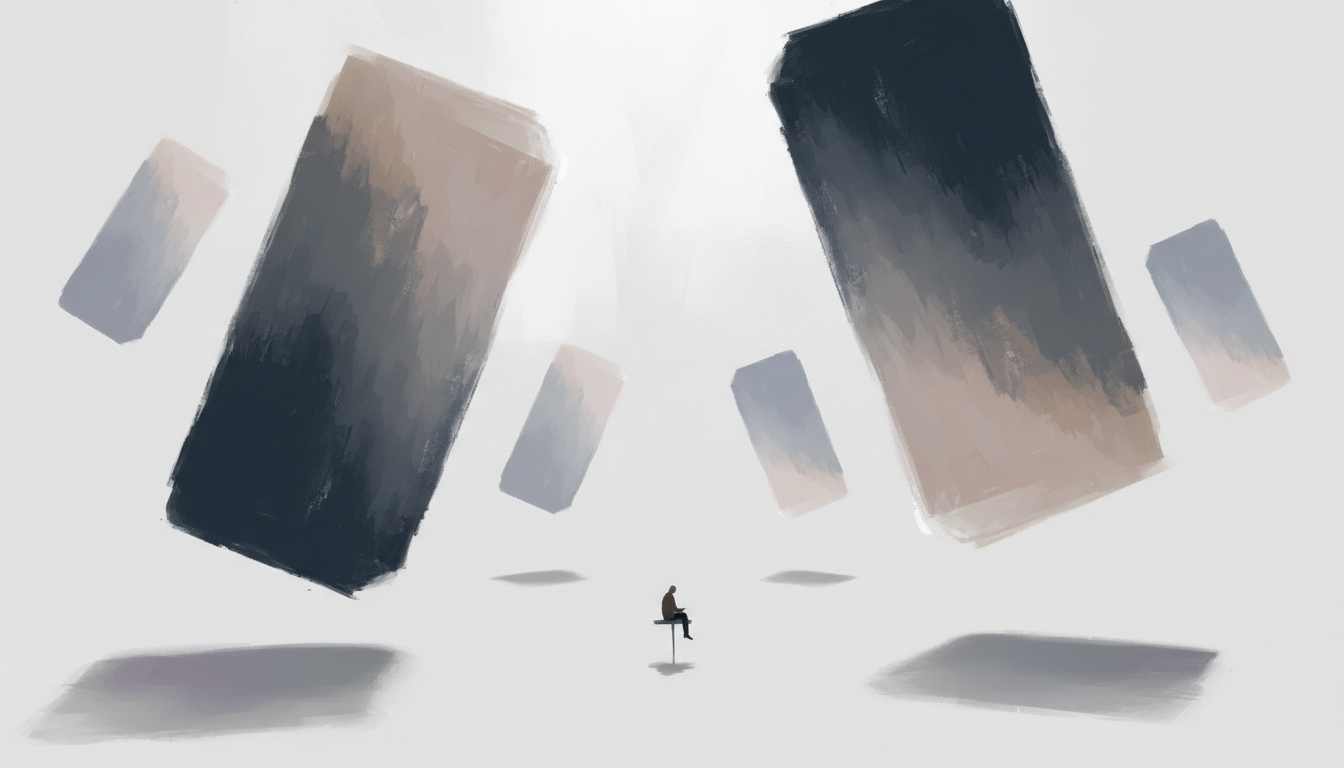
When the brain repeatedly interprets its environment as socially threatening, two significant neurological changes take place. The prefrontal cortex, the area responsible for rational thinking, emotional regulation, and long-term perspective, becomes measurably less effective. At the same time, the amygdala, which functions as the brain's threat detector, grows hyperactive. The result is a nervous system in a state of constant vigilance: minor friction triggers outsized reactions, someone else's success feels threatening, and even well-intentioned feedback is processed as an attack.
This is not a personality flaw. It is neurobiology under sustained pressure, and it is reversible.
Why high-pressure, comparison-heavy environments amplify the problem
Environments built around ranking, constant evaluation, and zero-sum competition create a specific kind of chronic stress. When winning feels rare and losing feels constant, the brain adapts by staying permanently on guard. Social safety drops. People become defensive. A simple "no" is no longer processed as information, it registers as a verdict on one's worth.
Research on primates offers a striking counterpoint. When an animal rises in social status, serotonin levels increase significantly. When status drops, serotonin returns to baseline. But the more revealing finding is what higher serotonin actually produces: not aggression, not dominance-seeking, but calmness, assertiveness, and a greater capacity for collaboration. Lower serotonin, by contrast, correlates with impulsivity, volatility, and poor long-term decision-making. The neuroscience points to a clear conclusion: sustained performance comes from cooperation, not from fear.
Mood shapes thought, not the other way around
One of the most counterintuitive findings from antidepressant research is this: it is not negative thinking that creates a bad mood. It is bad mood that generates negative thinking. When serotonin function improves, the same events stop feeling threatening. Emotional reactions soften. People do not suddenly feel euphoric, they simply feel less under attack. That distinction is important, because it shifts the frame from "fix your mindset" to "address the conditions generating the threat response."
The harsh inner critic is not discipline, it is internalized pressure
Many driven professionals carry a relentless self-critical voice that they mistake for high standards. In reality, research suggests this inner critic triggers the same physiological stress responses as external criticism, keeping cortisol elevated and suppressing serotonin function. The voice that sounds like discipline may actually be maintaining the very neurological state that makes clear thinking harder. Creating even temporary distance from it allows the prefrontal cortex to come back online.
What resilience actually means, neurologically
Resilience is not the ability to feel nothing after failure. It is the speed at which the nervous system returns to a balanced state after disruption. Research has shown that deliberately imagining worst-case scenarios, and then working through their survivability, can reduce the amygdala's fear response over time. Fear loses its grip not by being avoided, but by becoming familiar. The nervous system shifts from threat mode to challenge mode, and that shift changes everything about how a person shows up at work.
What healthy systems actually look like
Organizations that want to unlock the full capability of their people need to understand that psychological safety is not a soft HR concept, it is a neurological precondition for performance. Environments built on clear expectations, shared progress, mutual respect, and genuine belonging allow collaboration to replace defensiveness, creativity to replace fear, and stability to replace the cycle of burnout and recovery. Small, consistent signals that a person belongs matter far more than occasional recognition, because the brain is always, quietly, listening.
A closing thought
Burnout and chronic workplace stress are not personal failures. They are, in many cases, rational biological responses to prolonged social pressure. Understanding this does not remove responsibility, it removes shame. And removing shame is often the first step toward better decisions, better relationships, and better work. Sometimes the most powerful realization is the simplest one: nothing is wrong with you. Your nervous system is responding to the world it is in.



.png)